
To determine the age of buildings that can be registered in the property registry based on age, and not on the completion of construction, there are two key rules:
1.- National Law and Registration Normative
- Royal Decree 1093/1997, of July 4, regulates the registration in the Property Registry of Acts of an Urban Planning Nature.
Article 52 contemplates the possibility of registering existing constructions carried out without a building permit, provided that it is proven that the date of completion of the work is prior to the statute of limitations for the building violation that the builder may have incurred.
This circumstance can be proven by means of a technical certificate (see example), which includes the description of the existing construction and the date of completion of the works.
- State Land Law: Royal Legislative Decree 7/2015, of October 30, which approves the consolidated text of the Land and Urban Rehabilitation Law
Article 28. Declaration of new construction.
- (declaration of work in the ordinary way, that is, through a license and completion of work) To authorize deeds of declaration of new construction, notaries will require, for their testimony, the provision of the act of conformity, approval or administrative authorization that the work requires according to the territorial and urban planning legislation, as well as a certificate issued by a competent technician and accrediting the adjustment of the description of the work to the project that has been the subject of said administrative act.
In the case of deeds declaring completed new construction , they will require, in addition to the certification issued by a competent technician attesting to the completion of the construction in accordance with the project description (the completion certificate) , the documents that prove the following points:
- a) compliance with all the requirements imposed by the building regulations for the delivery of the building to its users and (the building permit)
- b) the granting of the necessary administrative authorizations to ensure that the building meets the necessary conditions for its intended use as defined in the applicable urban planning regulations (the occupancy license-Certificate of Habitability) and the energy efficiency requirements as demanded by current regulations, unless urban planning legislation subjects such actions to a prior notification or responsible declaration regime , in which case those authorizations will be replaced by documents that prove that the notification has been made and that the established period has elapsed so that the corresponding activity can begin, without the existence of any obstructive resolution from the Property Registry.
- (here it refers to the declaration of work based on age) Notwithstanding the provisions of the preceding section, in the case of constructions, buildings and installations for which it is no longer appropriate to adopt measures to restore urban planning legality that imply their demolition, because the corresponding limitation periods have expired , the registration of the completion of the work shall be governed by the following procedure:
- a) Deeds of declaration of new construction, accompanied by a certificate issued by the City Council or a qualified technician, a notarial deed describing the property, or a descriptive and graphic cadastral certificate of the property, stating the completion of the work on a specific date and its description coinciding with the title, shall be registered in the Land Registry. For these purposes, the Registrar shall verify the absence of a cautionary notice for the initiation of urban planning disciplinary proceedings on the property subject to the construction, building, or installation in question, and that the land is not public domain or affected by easements for general public use.
- b) Property Registrars shall inform the respective City Council of the registrations made in the cases covered by the preceding paragraphs, and shall record in the registration, in the dispatch note, and in the official publication they issue, the execution of said notification. – Hence, we often find entries in the simple notes stating that the Registry has sent a report to the City Council to notify a declared work without providing the documents required in the standard manner (Building Permit + Completion Certificate).
- c) When the new construction has been registered without a certificate issued by the corresponding City Council, the latter, once it has received the information referred to in the previous letter, will be obliged to issue the necessary resolution to record in the Property Registry, by marginal note to the registration of the declaration of new construction, the specific urban planning situation of the same, with the delimitation of its content and express indication of the limitations that it imposes on the owner.
Failure to issue the resolution authorizing the entry of the aforementioned marginal note will result in liability for the competent authority if the bona fide purchaser of the property affected by the proceedings suffers economic losses. In such a case, the aforementioned authority must compensate the bona fide purchaser for the damages incurred.
2.- Regional normative
As we have seen, the registry and state regulations establish that constructions can be registered in those cases where measures to restore legality cannot be adopted (i.e., demolitions).
Therefore, the “key” is knowing “WHEN” restoration measures can no longer be taken on a building?
the regional law says , which is the one that has the powers.
Let’s look at some examples:
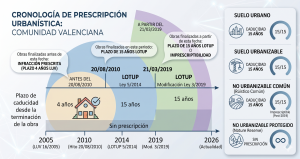
I.- Valencia Region – LUV AND LOTUP
The expiry period for ordering the urban restoration of a construction carried out without a building permit, or without complying with its provisions, has changed in successive modifications of urban planning legislation:
– Until the approval of the 1st version of the LOTUP 19/08/2014 including:
Before the LOTUP 2014, the LUV (Law 16/2005, Valencian Urban Planning Law) was in force, which established a period of four years from the total completion of the works, provided that these were not built on land classified in the planning as green areas, roads, open spaces or public facilities, land or buildings belonging to the public domain or included in the General Inventory of Valencian Cultural Heritage, or on protected non-developable land. (art. 224)
– 2014-2019 – Interval between the 1st LOTUP and the 2nd LOTUP 21/03/2019 :
Since 20/08/2014: the LOTUP (Law 5/2014 on Territorial Planning, Urbanism and Landscape, of the Valencian Community ), in article 236, establishes a new period of 15 years .
This new deadline does not apply to works that, at the time this law comes into force, have already met the expiry period of 4 years established in the previous law , in force on the date of completion of the work.
Therefore, for those buildings that were built 4 years before the law came into force, the 15 years do not apply, but rather the previous legislation, that is, the LUV, which established 4 years.
– As of the 2nd LOTUP 03/21/2019:
This law:
1.- URBAN AND URBANIZABLE LAND : Continues to maintain the 15 years for constructions on Urban and Developable Land.
2.- RURAL LAND-NON-URBANIZABLE : Introduces two important modifications:
– It introduces the imprescriptibility of non-urbanizable land . Law 3/2019 modifies article 236 of the LOTUP, excluding any construction on non-urbanizable land from prescription.
Therefore, the infractions for all constructions that:
– They have been built on common rural land
– They were built after August 2010
They do not prescribe
Let’s imagine several cases:
CASE 1.- Date of construction: 2008
Expiration period according to regulations (LUV): 4 years
Four years have passed since LOTUP 2014 came into force: YES
Has it expired according to the current LOTUP? : YES
Can I register?: YES
CASE 2.- Construction date 2012
Expiry period according to LOTUP 2014 regulations: 15 years
15 years have passed since the entry into force of LOTUP 2019: NO
Has it expired under current law? : NO
Can I register?: NO
– LEGALIZES CONSTRUCTIONS IN RURAL AREAS PRIOR TO 1975. The second final provision of the LOTUP establishes that isolated buildings on non-urbanizable land that were completed before 25/05/1975 (date of entry into force of Law 19/1975 reforming the Law on the land regime and urban planning), continue to maintain the use and typological characteristics they had on that date and are not in a legal situation of urban ruin, are assimilated to works with a license (structural reform, rehabilitation, and reconstruction)
Conclusions on Valencia Region
To be on the safe side and avoid any objections from the Registrar, the date that the technician should certify would be:
URBAN AND DEVELOPABLE: more than 15 years .
RUSTIC: Before August 2014
- Ideal date: Sometime in 2010 or earlier .
- Why? Because having passed 15 years, you meet the maximum term established by Art. 261.1 for any type of land (before the 2019 reform of imprescriptibility).
OTHER COMMUNITIES ( updated April 2026)
Autonomous Community | General Deadline | Note on Rustic Soil |
Andalusia (LIST) | 6 years | Generally 6 years, except in areas of special protection. |
Catalonia | 6 years | It remains at 6 years for most assumptions. |
Madrid | 4 years | It has one of the shortest deadlines, but it is very closely monitored. |
Balearics | 8 years | Note: In protected rural areas, it never expires . |
Galicia | 6 years | Standard deadline after the latest reform of the Land Law. |
the Basque Country | 5 years | Very serious offenses result in 5 years; serious offenses, 4 years. |
Murcia | 4 years | Short term, similar to that of Madrid. |
Cantabria | 4 years | 4-year statute of limitations for serious/very serious offenses. |
Asturias | 4 years | The traditional 4-year term remains in place. |